After, 18 March 1915 blow, General Hamilton had informed Lord Kitchener that
without a land operation it was impossible to defeat the strong Turkish defences. From the
beginning, Kitchener and Churchill were insisting on that a naval attack was
efficient to open the strait. However, after considering the failure of 18 March, they
accepted Hamilton's suggestion.
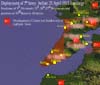
| Deployment
of the Turkish 5th Army |
Landing Plan
of the Allies |
 |
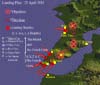 |
General Ian Hamilton had planned to disembark
two British divisions, one French division and one Indian division to Helles (Seddulbahir)
and the Anzacs to Karatepe.
Meanwhile, 3rd and 16th army
corpses, six divisions, the cavalry unit and the independent battalions had styled the
Turkish forces. Afterwards, with the necessary dispositions the number of the Turkish
divisions had reached sixteen. |
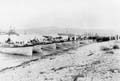
Shores of the Gallipoli Peninsula
|
Approximately a month before 25 April
landings, German Marshall Liman von Sanders was
appointed to command the Fifth Army Corps. He thought that the Ally Landing's initial
point would be the Basica Gulf (Saros). Therefore, he immediately stationed most his
forces on the Basica Gulf and on Suvla beach, a division on Seddulbahir and the 15th Corps
on the Asiatic shore.
In addition, he engaged observation and defensive units on the significant points
of the Peninsula and he stationed his main forces at the rear. In fact, the Turkish
commanders were against Sander's defence plan. They were advocating the plan, which had
been designed before German Marshall's arrival. This plan's focus was to block the enemy
in their weakest moment, the moment they embark. However, Sander's plan was put in
practise. After, the landings had begun, the Turkish commanders' additional dispositions
hindered the allies' advance and they were blocked in an area of 3-4 km long. |
 |
